
An Eight-Week Bodyweight Course for Adults Over Fifty
Strength you can trust, built with a chair, a wall, and your own weight
No gym membership. No dumbbells collecting dust in a closet. Eight weeks of progressive exercise, paced deliberately, so the body has time to actually adapt.
A Different Starting Point
Built for the body you have now, not the one you had at thirty
Sinuje began with a simple observation. Most strength programs are written for someone recovering from a hard leg day, not for a sixty-three-year-old who wants to keep gardening, keep traveling, and keep getting up off the floor without giving it a second thought. Each week of this course borrows from published research on aging muscle and balance, then translates it into movement that needs nothing more than a sturdy chair and a wall to lean against.
There is no equipment to buy and no gym membership to justify. There is only the work itself, spread over eight weeks so your body has time to adapt instead of being rushed into it. This is general fitness education, not physical therapy and not a medical program. It is meant to inform how you move, not replace the guidance of your own physician when something specific is going on.


The Test Nobody Talks About
Getting up from the floor without your hands
Ask most people over fifty how their fitness compares to five years ago and they will mention a treadmill time, a step count, maybe a bathroom scale. Almost nobody mentions whether they can lower themselves to the floor and stand back up again without reaching for a hand, a rail, or a piece of furniture.
Researchers studying aging and mobility have used exactly this kind of floor-to-stand movement as a marker of functional strength for decades, because it quietly demands hip mobility, leg strength, balance, and core control all at once. It is not a dramatic test. It is an honest one. Losing the ability to do it rarely happens overnight. It happens gradually, one skipped floor session at a time, until the option disappears without anyone noticing it was going.
Week seven of this course is built around this exact movement, broken into stages so it can be practiced safely, with a chair nearby for support while the pattern is learned.
What The Research Says
Balance training and the science of preventing falls
Falls are one of the more studied topics in geriatric medicine, and the research keeps circling back to the same finding: strength alone does not protect you the way balance does. Programs that include exercises challenging your center of gravity, weight shifting from one leg to the other, standing on an unstable base, slow directional changes, have been associated in published geriatric research with a meaningfully reduced rate of falls compared to strength work alone.
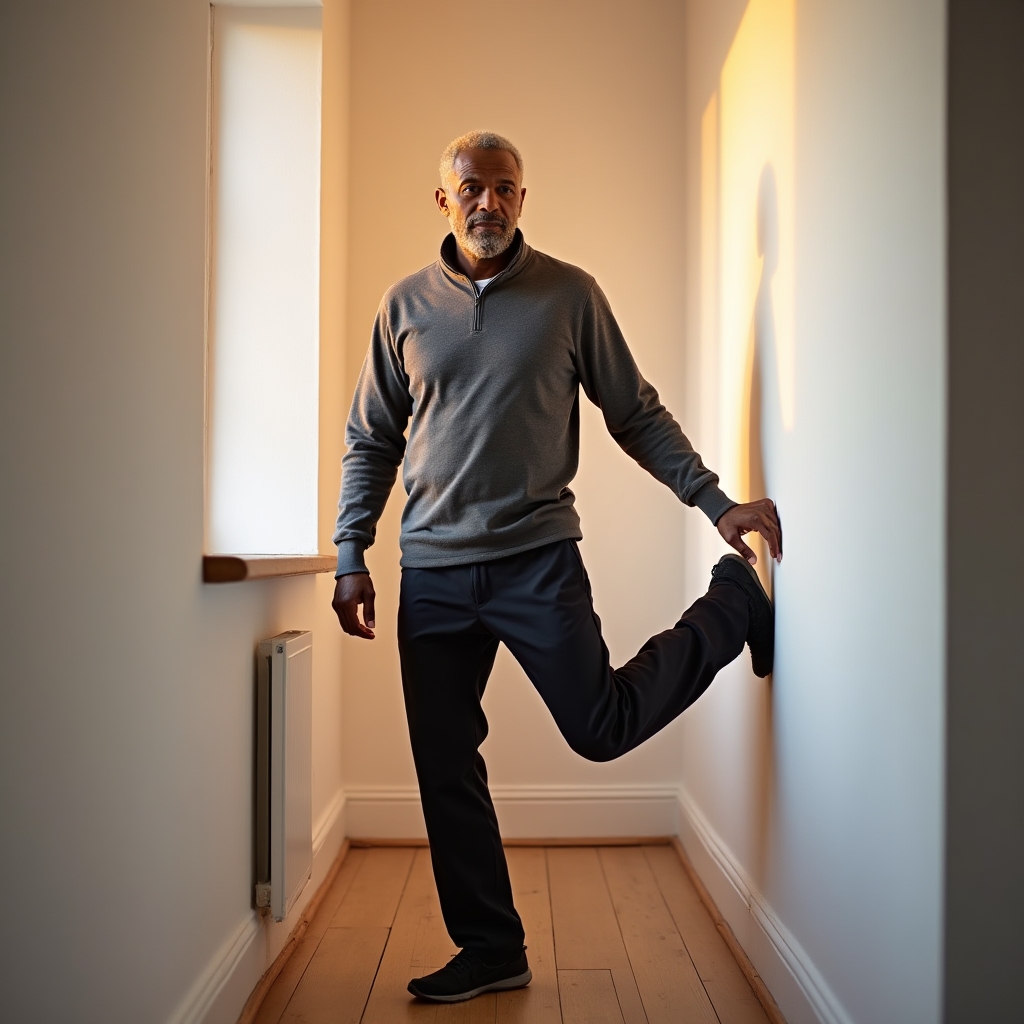
That research shaped how this course is sequenced. Balance drills are not saved for the end as an afterthought. They begin in week three, using the wall as a spotter rather than a crutch, and they build steadily alongside the strength work rather than sitting separately from it.

Sarcopenia, In Plain Language
Muscle loss after forty is real. It is not a sentence.
Exercise physiologists have a clinical name for age-related muscle loss: sarcopenia. It is a documented, measurable process, and it typically accelerates through the fourth and fifth decades of life if nothing interrupts it. That part is not in dispute.
What often gets left out of the conversation is the second half of the research. Resistance training, even the bodyweight kind that uses nothing more exotic than a chair squat or a wall push, has repeatedly been shown to slow this process and, in many cases, to rebuild a meaningful amount of the strength that was assumed to be gone for good. The muscle tissue responds to consistent load well into later decades. It simply needs to be asked to do something.
This course asks, gradually and repeatedly, for eight weeks.
How The Eight Weeks Are Structured
Four phases, paced so nothing feels rushed
Foundation
Weeks 1 and 2
Learning stance, breath, and the chair-assisted sit-to-stand pattern that underlies almost everything that follows.
Control and Balance
Weeks 3 and 4
Introducing single-leg holds against the wall and simple weight shifts to build the balance side of the equation.
Building Strength
Weeks 5 and 6
Slower tempos, longer holds, and the first floor preparation drills done with a chair close by for support.
Integration
Weeks 7 and 8
Full floor transfers, combined movement sequences, and an honest look at how far things have come.
What You Actually Need
A chair. A wall. That is the entire equipment list.
No resistance bands to order, no adjustable dumbbells to store. The course is deliberately built around objects that already exist in almost every home, so the only thing standing between you and week one is deciding to start.
A Sturdy Chair
Used for support during sit-to-stand work, balance drills, and as a safety point during floor practice.
A Clear Wall
Used for wall push variations, posture checks, and as a light-touch spotter during single-leg balance holds.
Common Questions
Before You Begin
No. Every movement in the eight weeks is designed around a standard dining or kitchen chair and an open stretch of wall. Comfortable clothing and enough floor space to lie down for a few minutes each session are the only other requirements.
It is not. This is general fitness education based on exercise science, built for people who are not currently receiving treatment for an injury or medical condition. If you are working with a physical therapist or recovering from a procedure, that professional relationship should take priority over anything found here.
Speak with your physician before starting any new exercise routine, especially if you have a diagnosed condition affecting your joints, heart, or balance. The course includes general guidance on listening to your body, but it cannot account for an individual medical history the way a healthcare provider can.
Sessions are designed to run between twenty and thirty-five minutes, three to four times a week, though the pacing is flexible. Some weeks include shorter, more frequent balance check-ins rather than one long session.
Both are built in deliberately. Balance work begins as early as week three and continues alongside the strength progressions through week eight, reflecting the research suggesting the two should be trained together rather than treated as separate goals.
Week one includes a gentle self-assessment, including the floor transfer test discussed above, so you have a personal reference point. It is meant for your own awareness, not for comparison against anyone else.